
May 27, 2026
Museum of Consciousness: Egypt's Restricted Mysteries with Carl Hayden Smith
Seven days down the Nile with Carl Hayden Smith. Nine temples, three sites under private permission, and a research question about how sacred space engineers consciousness.

Seven days down the Nile with Carl Hayden Smith, Associate Professor of Media at the University of East London and founder of the Museum of Consciousness. Nine temples, three sites accessed under private permission, and a single research question running through all of it: how do sacred spaces engineer states of consciousness, and what can ancient architectural protocols teach a modern nervous system.
Why this expedition
I first encountered Carl's work on the Antarctica voyage earlier in the year, where he ran sessions on Hyperhumanism and the relationship between technology and innate human capacity. The Nile expedition is the field-research extension of that work. Smith treats the Egyptian temple system as the oldest documented consciousness-engineering technology on the planet. Stone, acoustics, alignment, processional sequence, restricted access, all of it built into the architecture to produce a specific shift in attention and inner state. The seven days were structured to test that hypothesis site by site.
The setup
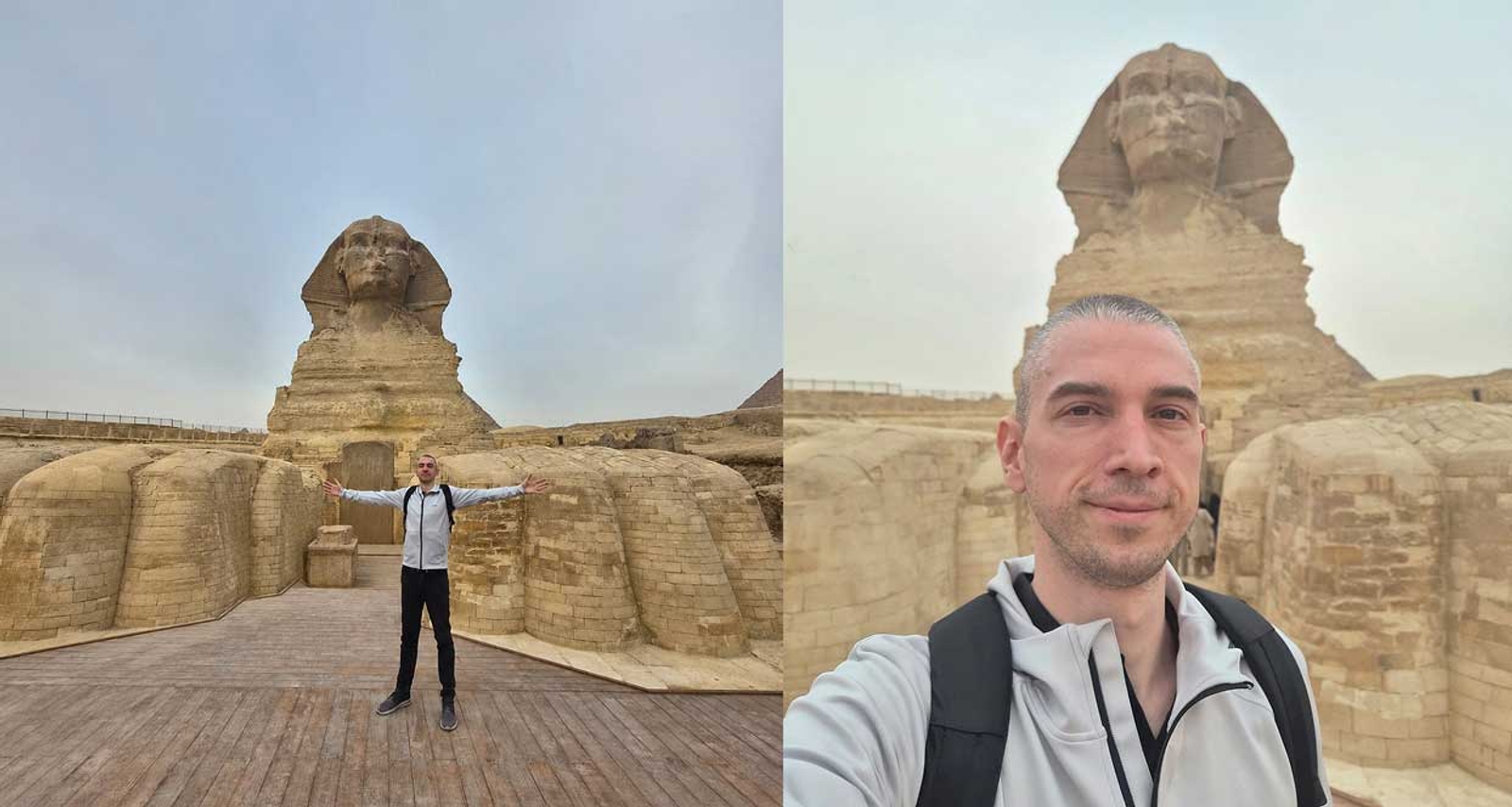
We flew into Aswan, boarded a boat, and sailed north over the week. The route ran Sehel Island, Philae, Kom Ombo, El Kab, Karnak, the Isis Temple at Deir el-Shelwit, and Dendera, ending in Luxor. Three of those sites we entered under private permission outside public hours: the Priestess Gate at the Temple of Isis at Philae, the Sekhmet chamber inside the Precinct of Amun-Ra at Karnak, and the Temple of Hathor at Dendera. The private access is the work. A temple full of tourists is a different signal than a temple at first light with a small group and a competent facilitator.
What the temples do
The thesis Smith teaches is that the temples are instruments. Each site is configured for a different purpose, and the configuration shapes what the visitor's nervous system can do inside it.
Sehel Island and the shrine of Anuket open the sequence on water, the goddess of the Nile inundation, the embracer, the entry point. Philae and the Priestess Gate run on contemplative quiet, the side entrance historically reserved for initiates and ritual functionaries, which still does what it was designed to do. Kom Ombo is the dual temple, Sobek and Horus the Elder side by side, the architecture itself teaching balance and the management of opposing forces. El Kab is older than the New Kingdom and barely touched by tourism, set against desert cliffs, and runs the cleanest signal of any site on the trip because there is almost no interference. Karnak is the scale piece: two thousand years of construction, the largest religious structure ever built, with the Sekhmet chamber tucked inside the Precinct of Amun-Ra functioning as a focal point that resets the whole sequence. Dendera and the Temple of Hathor close the trip with the astronomical ceiling, the crypts, and the precise alignment that holds the late-period religious system together.
The acoustic work
The sites do not behave the same way at sound. Smith's research focuses on how stone, enclosure, and resonance interact, and the temples reward that attention. Hypostyle halls behave one way. Sealed chambers behave another. The Sekhmet chamber at Karnak is small, dense granite, and produces an effect on the body that conference-room talks about altered states can describe but not deliver. Standing in it under private access at the right hour is the lesson. The architecture is the protocol.
What I took back into my work
Three things.
The first is that environment is a protocol. I have been treating it that way for years inside the retreats I run, but the Egypt sites raised the ceiling on what environment-as-intervention can do. Sound, geometry, restricted access, and sequence work on the nervous system at a depth that supplementation and breathwork alone cannot reach. That changes how I design the spaces my clients work in.
The second is sequence. The temples were never standalone sites. They were a processional system, ordered, with each site doing one specific job in a longer arc. The way Smith ran the seven days mirrored that. I am building that same sequencing logic into longer arcs inside my mentoring programs and the online academy, where most longevity content treats interventions as a flat list instead of an ordered protocol.
The third is the network. Direct time with Carl over a week of sites, plus the cohort of researchers, sound practitioners, and consciousness workers who came on the trip. This is the second time this year I have been in the field with that calibre of operator. Read the Antarctica field note and the Amazon field note for the other two pieces of the same year of research.

